Preserving the memory
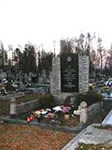 On the first anniversary of the end of the Second
World War, the community of the parish and municipality of Drelów
commemorated the occasion with an event that has since become part of the
region’s history. Feliksa Patkowska (wife of Antoni), Józef Huk from
Pereszczówka, and Anna and Bronisław Karwaccy from Łózki formed a committee
that undertook the construction of a monument at the parish cemetery in
Drelów and the symbolic bringing of the ashes of fighters for Poland’s
independence who were murdered in German prisons and concentration camps
between 1939 and 1944. On the first anniversary of the end of the Second
World War, the community of the parish and municipality of Drelów
commemorated the occasion with an event that has since become part of the
region’s history. Feliksa Patkowska (wife of Antoni), Józef Huk from
Pereszczówka, and Anna and Bronisław Karwaccy from Łózki formed a committee
that undertook the construction of a monument at the parish cemetery in
Drelów and the symbolic bringing of the ashes of fighters for Poland’s
independence who were murdered in German prisons and concentration camps
between 1939 and 1944.
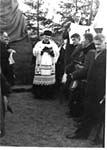
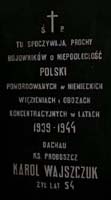 Feliksa Patkowska and Anna Karwacka travelled to the
State Museum in Auschwitz, and on 9 May 1946 they brought back an urn with
the ashes of the murdered. Jan Daniluk transported it by horse cart from the
railway station in Międzyrzec Podlaski to Drelów. At the entrance to the
village, near the cemetery, a ceremony welcoming the ashes took place. Rev.
Aleksander Kot participated with a procession, along with representatives of
the local authorities and school youth led by their headmaster Józef
Olszański, who read the roll of the fallen after words of welcome. The
gathered people wept with emotion. Feliksa Patkowska and Anna Karwacka travelled to the
State Museum in Auschwitz, and on 9 May 1946 they brought back an urn with
the ashes of the murdered. Jan Daniluk transported it by horse cart from the
railway station in Międzyrzec Podlaski to Drelów. At the entrance to the
village, near the cemetery, a ceremony welcoming the ashes took place. Rev.
Aleksander Kot participated with a procession, along with representatives of
the local authorities and school youth led by their headmaster Józef
Olszański, who read the roll of the fallen after words of welcome. The
gathered people wept with emotion.
To the sound of sirens and the mournful
tolling of bells, the urn was brought into the church and placed in a small
coffin on a catafalque. Rev. Aleksander Kot celebrated a requiem service,
after which the ashes were taken to the cemetery, where the funeral ceremony
took place. The urn was temporarily placed in the Karwacki family tomb. At
the beginning of September 1946, when the monument was completed, the ashes
were solemnly transferred to their final resting place. Thus the symbolic
remains of Rev. Karol Wajszczuk were laid to rest in the cemetery in Drelów
among his parishioners with whom he had once lived, worked and suffered.
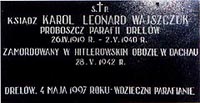 On 4 May 1997, during the celebrations of the 500th
anniversary of Drelów, a memorial plaque commemorating Rev. Karol Wajszczuk
— priest and martyr — was unveiled in the parish church of the Nativity of
the Blessed Virgin Mary in Drelów, the “silent witness” of the martyrdom of
the Uniates in 1874. This fact shows that despite more than half a century
having passed, the memory of their parish priest remains alive and cherished
among the parishioners. On 4 May 1997, during the celebrations of the 500th
anniversary of Drelów, a memorial plaque commemorating Rev. Karol Wajszczuk
— priest and martyr — was unveiled in the parish church of the Nativity of
the Blessed Virgin Mary in Drelów, the “silent witness” of the martyrdom of
the Uniates in 1874. This fact shows that despite more than half a century
having passed, the memory of their parish priest remains alive and cherished
among the parishioners.
On 10 November 1999, in Łózki near
Drelów, a monument commemorating murdered members of the Polish Military
Organization was unveiled. Among the names on the monument was that of the
long-time POW chaplain and martyr — Rev. Karol Wajszczuk. The unveiling was
carried out by Stanisław Stańczuk, son of Marek Stańczuk; Deputy Marshal of
the Sejm Franciszek Stefaniuk; Biała County Governor Tadeusz Łazowski; and
Mayor of Drelów Adam Szulik. The monument was blessed by the parish priest
of Drelów, Rev. Roman Wiszniewski. Soldiers from Military Unit No. 1861 in
Bezwola also participated in the ceremony.
 The history of the POW monument in Łózki dates back
to the interwar period, when the POW chaplain and parish priest of Drelów,
Rev. Karol Leonard Wajszczuk, initiated the construction of a monument
commemorating three POW members murdered in 1918: Wacław Wawdyś, Marek
Stańczuk and Józef Zahajkiewicz. The monument was unveiled on 8 November
1936 with the participation of guests and numerous school youth. After the
outbreak of the Second World War the Polish Military Organization resumed
its activity under the name “Nasze Orły.” The fate of its members was tragic.
In 1940 Rev. Karol Wajszczuk was arrested and through imprisonment at Lublin
Castle and Sachsenhausen concentration camp was later transported to Dachau
and then to the Hartheim euthanasia center, where he was murdered in a gas
chamber. A similar fate befell many other members. The monument was
dismantled by the Germans. The history of the POW monument in Łózki dates back
to the interwar period, when the POW chaplain and parish priest of Drelów,
Rev. Karol Leonard Wajszczuk, initiated the construction of a monument
commemorating three POW members murdered in 1918: Wacław Wawdyś, Marek
Stańczuk and Józef Zahajkiewicz. The monument was unveiled on 8 November
1936 with the participation of guests and numerous school youth. After the
outbreak of the Second World War the Polish Military Organization resumed
its activity under the name “Nasze Orły.” The fate of its members was tragic.
In 1940 Rev. Karol Wajszczuk was arrested and through imprisonment at Lublin
Castle and Sachsenhausen concentration camp was later transported to Dachau
and then to the Hartheim euthanasia center, where he was murdered in a gas
chamber. A similar fate befell many other members. The monument was
dismantled by the Germans.
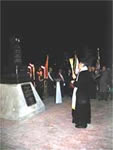 In 1999 a committee for the reconstruction of the
POW monument was formed, headed by Czesław Małoszuk from Łózki. The
reconstruction was completed in November 1999. In addition to the names from
the original monument, the new memorial also included the names of the
parish priests of Drelów: Rev. Karol Wajszczuk and Rev. Leon Gliszczyński. In 1999 a committee for the reconstruction of the
POW monument was formed, headed by Czesław Małoszuk from Łózki. The
reconstruction was completed in November 1999. In addition to the names from
the original monument, the new memorial also included the names of the
parish priests of Drelów: Rev. Karol Wajszczuk and Rev. Leon Gliszczyński.
As further evidence of remembrance,
during commemorations held at the Higher Theological Seminary of the Diocese
of Siedlce named after John Paul II, memorial plaques dedicated to priests
who gave their lives for God and the Fatherland during the January Uprising
and the Second World War were unveiled and blessed. Among the honoured names
was Rev. Karol Wajszczuk, parish priest of Drelów during the interwar
period.
|














)
)
)
)
)
